From ‘Jullay’ to ‘Salam Alaykum:’ a Road Trip in Himalayan India
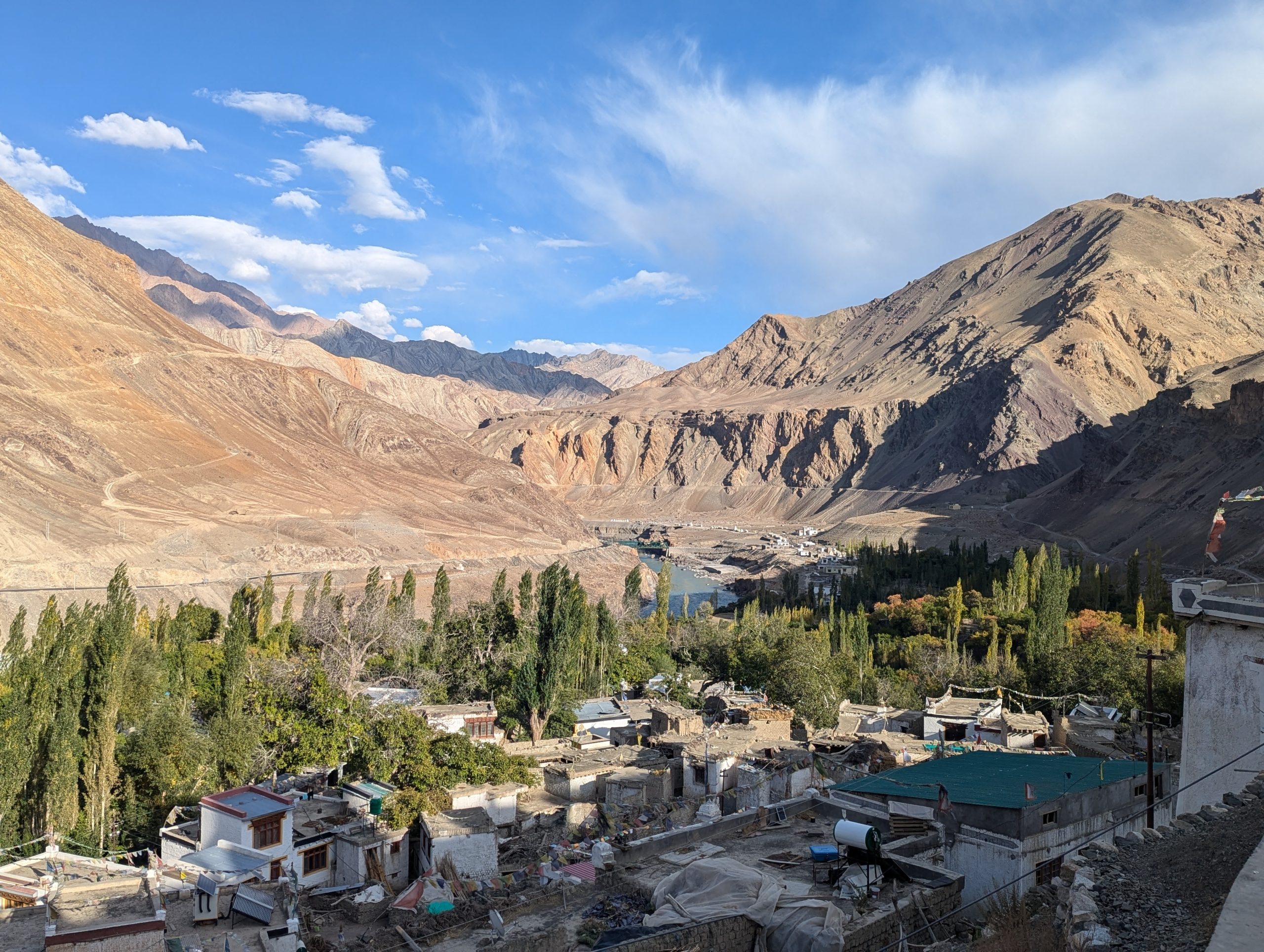
One of many regions where India’s diversity is illuminated is in the north of the country, within the Himalayan mountains and valleys. From listening to the teachings of a Buddhist monk in Ladakh to hearing the Islamic calls to prayer five times a day in the Kashmir valley, our road trip through the Indian Himalayas took us across geographically and culturally distinct neighboring regions, both distinguishing themselves from India’s Hindu majority.
Leh: a warm welcome to Ladakh
We flew from Delhi into Leh, one of Ladakh’s two capital cities. In the plane I woke up to see a dramatic range of dry, brown mountains with green stretches in the valleys, mostly poplar and willow trees. Upon arriving in the small airport in Leh we were received with white khatags, ceremonial scarves offered as a sign of greeting, gratitude or respect. James suggested that I learn the word “jullay” (pronounced joo-lay), as it is used to say hi, bye or thank you. Over the next couple of weeks I would hear and say jullay, while bringing my right hand to my forehead.
During those two weeks in Ladakh we reminisced about James’ past at SECMOL, visited friends, saw breathtaking landscapes, immersed ourselves in the Ladakhi culture and witnessed their present struggles.
The majority of the population of Ladakh’s eastern district of Leh are Buddhist. It’s common to see prayer wheels in every neighborhood, as well as Buddhist monasteries in almost every town. Most people walk with their hearts in their hands. During our time there we were the recipients of kind words, charitable advice and delicious home-made meals.
A typical day involved visiting a friend’s house, removing our shoes at the door, and sitting comfortably on the floor mats in the kitchen. We would drink spiced milk tea, enjoy a fresh vegetarian meal, and engage in candid conversation. Cooking is central to the social setting and our daughter Vienna was often invited to join in the preparations.

Logistics for our road trip
After spending three weeks in Ladakh, it was time to move on. We had decided we would visit the Kashmir Valley next. Initially, we planned to fly there, but our friend Tashi, with whom we were staying, recommended a road trip through the Indian Himalayas. “You will miss all the beauty on the way if you fly,” he said. We later realized he was right, and his advice was for the best.
Transportation
Buses operate between Leh and Srinagar, sometimes driving for up to 18 hours with only brief stops, which wasn’t suitable for us. We could have taken multiple local buses, stopping along the way, but this too would have been complicated given the set times for each bus along with our chosen route and the baggage we carried. Car rental services are available in Leh but we were hesitant to navigate narrow Himalayan roads while adjusting to driving on the left. And so we decided to splurge and hired a car with a driver for four days and three nights. This cost nearly double the airfare for the three of us but was well worth it. A cab cooperative in Leh sets regional prices, simplifying the transaction process.
Route
While the typical journey between Leh and Srinagar follows the Srinagar-Leh highway, we opted for an alternative path. From Leh to Kargil, we turned north at Khalsi, traveling through the charming towns of Takmachik and Garkone, which we wanted to explore. Although this road is narrower and less maintained than the highway, the stunning landscapes make it worthwhile. After reaching Kargil, we rejoined the highway all the way to Srinagar.
This trip can be completed in just two days, but we chose a four-day journey with 3-4 hours of driving each day. This allowed us to enjoy a leisurely pace and fully experience the villages we visited. The places where we stayed were selected based on James’ past experience in the region, and the recommendations of our friend Tashi who is an expert in Ladakh’s tourism. You can find a map of our journey at the end of this post.
Road
The initial stretch of the journey through Ladakh mostly runs along the Indus River. We navigated stunning mountain passes and striking rock formations, observing the shift from Ladakh’s arid terrain to the vibrant, lush valleys of Kashmir. The road is typically well-maintained, although narrow in places with high passes. It’s advisable to have an experienced driver and to keep passports handy for the numerous checkpoints along the road.
During our journey we visited several towns, each with its own unique traditions. The experience entailed a gradual yet considerable cultural shift, so much that reaching our destination felt like arriving in a different country. While Ladakh and Kashmir are both part of India geopolitically, they are distinct entities in many other ways.
Alchi: an old monastery and a spiritual encounter
We had visited the town of Alchi by bus on a separate trip, but the town lies along the more direct route to Srinagar mentioned above so is worth mentioning. It is home to the Alchi Monastery, known as the oldest in Ladakh. I had wanted to learn about Buddhism and sought the guidance of a recommended monk in Alchi to learn about Buddhist beliefs and lifestyle. My learnings surpassed what I can write in this short post but were an important piece of my spiritual journey.
The Alchi monastery was built between the 10th and 11th centuries. It features original wall paintings, sculptures, wood carvings and stupas from that time, creating a peaceful atmosphere for visitors. The town itself receives some visitors attracted by the monastery specifically. Alchi offers a few restaurants, hotel facilities, and a small artisan market. Upon arriving by bus, another visitor we came across showed us the way to her homestay where there was one more room available. We met fellow travelers from other parts of India and enjoyed the comfort of Ladakhi hospitality and cuisine.

Takmachik: an organic eco-village by the Indus River
Amid the brown mountains of the Indus River valley, Takmachik’s lush greenery comes as an oasis of life. There are about 50 houses in the village lying on the slope of the mountain. A short walk led us to a monastery perched at the village’s highest point, featuring numerous prayer wheels, mani stones carved with the buddhist prayer Om Mani Padme Hum, and a breathtaking view of the mountains.
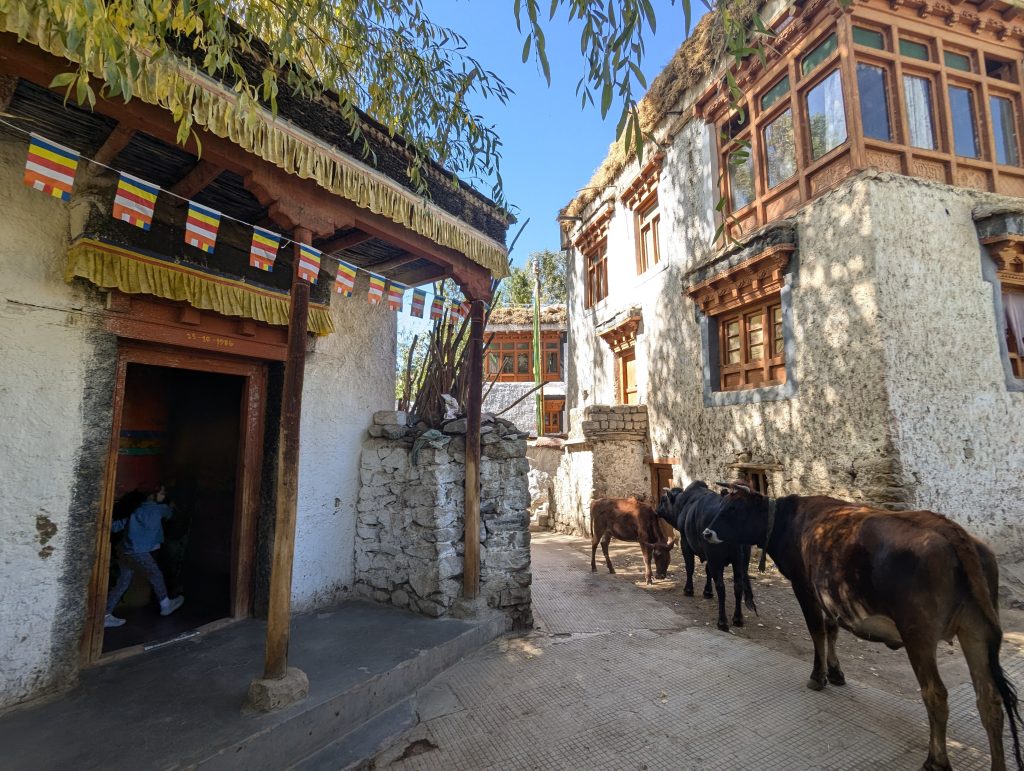
Vienna enjoyed playing with other children on the main street while some villagers kept an eye on them. It was the essence of community, where everyone shares responsibility for their neighboors’ wellbeing.
Takmachik was a pilot for organic agriculture and sustainable development in Ladakh. During the program’s first two years produce was limited, but Takmachik now grows the region’s sweetest apricots, along with other vegetables such as wheat, peas, barley, cabbage, and tomatoes. Apricots are the most common fruit of Ladakh, and this village’s harvest could be one of the best in the world.
Some villagers have been trained in eco-tourism. We enjoyed a comfortable stay with a local family, who prepared delicious, traditional Ladakhi dishes including rice, lentils, and bread. They also generously gave us apricots for the road and warmed our hearts with their beautiful smiles.

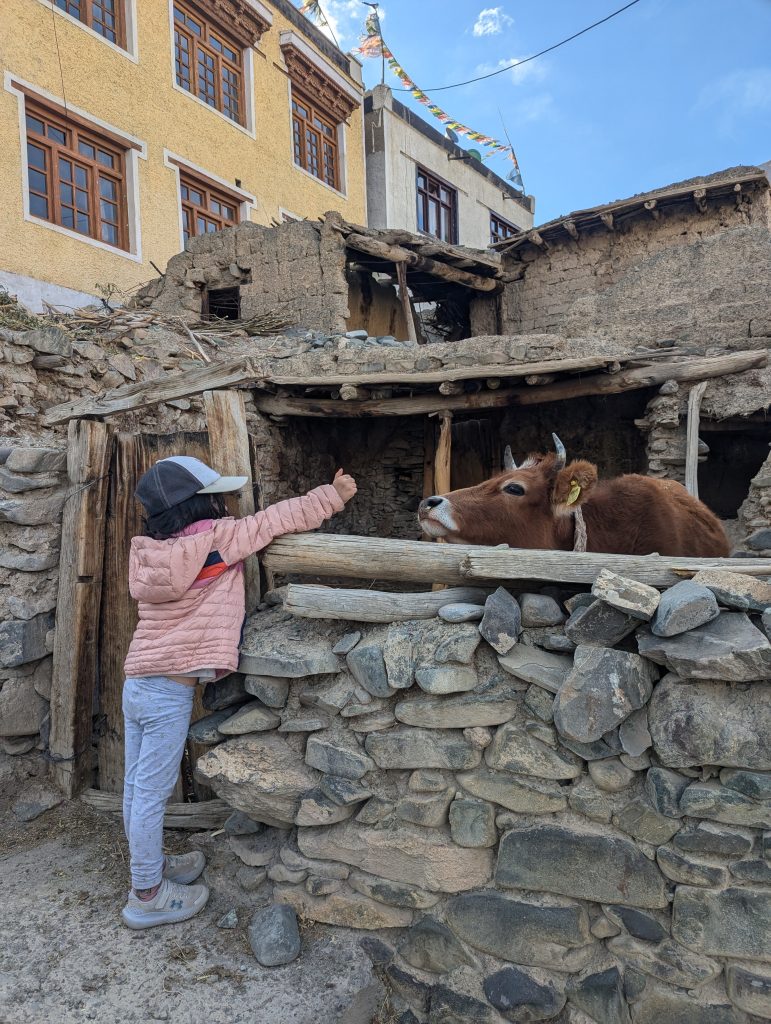


Garkone: an authentic Aryan village
Located in an area of stunning scenic beauty and rich heritage, the village is believed to be home to Indo-Aryan descendants. After traveling for hours along the turquoise waters of the Indus River, through rugged mountains and charming villages, our arrival in Garkone was quite pleasant.
While the village is part of Ladakh and its residents speak Ladakhi, unique traditions set the Aryan Valley villages apart. The most noticeable distinction lies in women’s attire. Elderly women adorn themselves with floral hats and waist-length braids, while others often cover their hair with vibrant scarves. Marriages typically occur within the same village, with ceremonies spanning several days and engaging the whole community. Births are also celebrated village-wide. In Garkone, a central plaza serves as the main point for major celebrations and daily gatherings with neighbors.
We saw peppers drying on rooftops, and barns seamlessly blending with the houses and landscape, which shelter livestock during the cold winter months. There are several agricultural terraces around the village, and a short hike leads to a Buddhist stupa, a Hindu statue, and a waterfall. The village is small in size (although its 100 households make it sizeable for Ladakhi standards). Tourists usually stay in guest houses offering food and accomodation. The road to Garkone often gets blocked in the winter due to snow storms, prompting villagers plan and prepare for long stretches of isolation from the outside world.


Kargil: Ladakh’s western capital
Kargil is the capital of Ladakh’s western and predominantly Muslim district of the same name. It was the only major city we visited during our road trip through the Indian Himalayas. Many tourists stop here to break up the journey between Leh and Srinagar. Located in the Suru Valley, the first thing we noticed when we arrived was the Suru river dividing the city. The second was the significant cultural shift from the Buddhist majority in eastern Ladakh, to the Muslim majority in the Kargil district.
The religious shift was evident through visual clues, especially architecture and dress. However, the deeper connotations go beyond what the eye can see, it shapes the lifestyle and influences social interactions. Across India, religion serves as a foundational element of the social fabric.
We stopped for lunch and noticed a distinct culinary shift from Leh, Ladakh’s eastern district. The menu transitioned from predominantly vegetarian to largely non-vegetarian fare. I experienced my first Kashmiri meal here, featuring spiced chicken in a rich sauce, accompanied by rice and bread. Typical meals in the region include mutton.
Drass: “the second coldest inhabited place in the world”
Although Drass is located in a beautiful part of the valley of the same name, the town itself does not have much to offer to the tourist. It is situated on an inhospitably traffic-heavy stretch of road so a leisurely stroll was out of the question. The town is famous for having cold winters and is marked with a sign that reads “J&K Welcomes you to Drass, the second coldest inhabited place in the world.”
Infrastructure is limited, and the quality and cleanliness of hotels and restaurants falls short compared to other towns in the region. To speak from our brief personal experience there, we did not find Drass to be the most cheery or welcoming place in our travels. We spent the night in a less-than-ideal hotel and departed early the following day to commence the final leg of our road trip through the Indian Himalayas.

Sonamarg: our entry to the Kashmir Valley
After leaving Drass, the landscapes became more open. We passed several military camps and passport checkpoints. Despite Google Maps showing the border with Pakistan far off, we were only a few miles away. This is due to the Indo-Pakistan war in 1971, after which a de-facto border known as Line of Control (LoC) was established, although it has never been officially recognized. The LoC is close to the Leh-Srinagar highway in some sections.
We also went through the famous Zoji-la pass, one of the highest motorable mountain passes in the Himalayas. The views were breathtaking, especially because of the precipices on our side of the road. Beyond the pass we encountered a mountain full of pines, a sign of the vibrant life ahead. The landscape turned into lush greenery as soon as we arrived at Sonamarg.
We stopped for a local lunch and enjoyed a popular horse ride through the valley to a glacier viewpoint, both activities loved by Vienna. Sonamarg stands out as a top destination in the Kashmir Valley due to its alpine-like landscapes. The town itself doesn’t have major attractions, featuring just one main street lined with local restaurants and a few hotels just outside of town. A large plot hosts numerous horses for riding, many of which are unfortunately kept in poor conditions.
Sonamarg was the last stop of our road trip through the Indian Himalayas before we reached Srinagar.


Srinagar: one of the most stimulating cities we have visited
With that, we arrived in Srinagar, a rich history spanning thousands of years. Srinagar lays in a beautiful section of the valley, surrounding Dal Lake. Each morning, we would awaken to the calls to prayer and open the curtains to a foggy landscape. Taking a shikara (colorful wooden boat) around the lake was a peaceful activity that we enjoyed on more than one ocassion. The food, like in many parts of India, is quite spicy for the typical westerner. With little international tourism, locals were usually friendly and curious about us.
Srinagar has been at the center of Kashmir’s struggles for peace and autonomy, the struggles of a Muslim city disconnected from the predominantly Hindu nation it belongs to. Throughout our stay we discovered the deep impact of invasions, wars, and heavy military presence in the everyday lives of its residents. After days of conversations, we began to grasp the complexities of Srinagar’s history and present struggles. Our visit was both captivating and concerning at times.
Kashmiri is the predominant language spoken in Srinagar, though Urdu, English, and other languages are also widely used. Over the next couple of weeks, we frequently found ourselves shyly saying “Salam Alaykum.”


A map of the route*
*Note that Google Maps automatically shows the route heading to Lamayuru and back, which we did not do. However, it should be noted that Lamayuru is a popular destination for tourists in Ladakh due to its beautiful monastery complex and surroundings.