Planning a Fulfilling Family Gap Year

If you’re considering taking a gap year as a family, then you’re probably seeking something deeper or more extensive than a vacation. Whatever that means for you, the following actions could help you in planning a fulfilling family gap year. These are not logistical tips (visas, packing and the like) but rather insights for having a richer and more meaningful experience.
Gap years come in all forms and might not even last a year. They don’t necessarily include travel. They might include some form of work. And they may or may not involve signing up for a formal program. To avoid disillusionment while planning, try to keep an open mind about what your gap year should involve.
Reflect on what you will be stepping away from
Before you plan ahead, think about what you’ll be moving from and how you want to handle this. Messy departures can lead to nagging feelings or regrets. How can you leave with the best possible feelings about your work and your professional and personal relationships?
Hopefully you have a job you at least reasonably enjoy. In this case you may feel more fulfilled giving longer than the traditional two-week notice so that you can wrap up projects, share knowledge, or connect with colleagues.
If your gap year will take you elsewhere, what will your absence mean for your extended family or community? Perhaps more than you realize! What will your departure mean for you and your family? Are there activities you’ve been meaning to do but haven’t gotten around to? People you’ve been meaning to catch up with? It’s not too late!
Planning a move can leave you feeling like it’s not worth deepening your relationships where you currently live. Especially if you won’t be returning to your current location following your gap year. If you’ll be moving a few times during your gap year though, you of course don’t want to be constantly thinking about “what’s coming next” at the cost of missing what’s right in front of you. Try thinking about your current life as the first phase of a gap year. How would you approach life if your gap year had already started?
What might change about your current routine and those of your family members? Is there a way to start incorporating some of these expected changes into your life tomorrow? If you have kids, are there conversations you can have to prepare them for new routines?

Finally, think of a few things that you most enjoy about your work and personal life today, and a few that you feel absolutely must change after your gap year. “Selective memory” can confuse the way we think about our pasts. Before that happens, take note of what’s working (or not) so that you can be focused when it comes to settling into a new routine after your gap year.
Family gap year tip: Talk about and understand what “leaving” means to the other members of your family. This may be harder for one person than the others realize.
Define your broad intentions
Is there one sentence that defines your intentions for taking a gap year? Do your reasons change each time you talk about your plans? Take some time to consider what the full potential impact of a gap year could be for you and your family and how that could be boiled down to a few words. Those words may become guideposts if you find yourself getting “off track” from your original intentions. Here are a few questions to consider as you define your broad intentions:
How could you use this time to more fully embrace your values and interests, or to develop skills that are in line with them?
If you like your work or field, then should your gap year involve keeping up contacts in the industry or volunteering with a related organization?
If you’ve taken lots of short trips but now want to travel open-endedly, how will this differ from a vacation? Will you be spending a longer stretch of time in one or more places? What can you do there to make the most of your time? How can you incorporate local engagement?
Are you looking for a more sweeping change in the way you go about your individual and family life? Are there things you feel you should be prioritizing more than you have in the past?
See if you can come up with a single sentence that defines your broad intentions for taking a gap year.
Family gap year tip: With your partner (and children if old enough), discuss the way you’ve each been talking about your upcoming gap year with other people. See if you can come up with a “gap year mission” together, which captures your shared intentions.

Outline a few specific goals and how you could act on them
Once you have a broad sense of your intentions, outline a few specific goals for growth and learning. For example, you may want to participate in an activity that embraces a certain value, build skills for a career change, create art, experience cultural immersion, develop language skills, work on your health, or have more family time.
With respect to each goal are there specific ends you have in mind? If you want to work more on art, is there a “final product” you aim to produce? If not, are you hoping to develop a technique for a specific future purpose beyond your gap year?
Consider how you’ll act on your goals. If you want to develop industry-specific skills and knowledge, jot down all of the organizations you could potentially connect with during your gap year, whether as a volunteer or even just for a short informational visit. If language and culture are your interests, what is your language learning plan and what kinds of activities will lead to local engagement?
You may realize there are dozens of things you’d like to work on during your gap year. Hopefully you’ll make time for all of them but try to prioritize just a few. Otherwise you may feel frustrated down the line that you haven’t achieved one or more of the things you promised yourself you’d do.
Your goals may change along the way. Such is life. But having them sketched out in advance is a great way to help set yourself up for a fulfilling family gap year.
Family gap year tip: If your kids are old enough, ask them if there is one main skill they’d like to work on during their gap year (in addition to the normal childhood learning that will take place). If they are toddlers or younger, you may just want to think about how to occasionally make their experiential and play-based learning a bit more formal. A simple example is afternoon crafts where you create some of the things they’ve seen or learned about throughout the day. It’s usually easy to find craft materials inexpensively even if you’re traveling.


Consider how your days will be structured
Now that you’ve defined a few goals, think about when you will work on them. Of course, your whole gap year doesn’t have to be goal-oriented. You should be enjoying the ride, relaxing, and sharing joyful moments with your family as much as possible. That said, it’s helpful to discuss what kind of time you will each need to focus on individual goals.
During our gap year one of us would actually say we’re “going to work” when we were about to focus on a personal project or go to a class. This helped us approach our projects more seriously (despite not having a “boss”). It also made it easier to explain to our toddler where the other parent was at times.
If you’re traveling as two parents there may be activities that you both enjoy but which your child or children aren’t ready for. In our case one example was bigger hikes. That might mean you’ll need to split up time to do these things individually sometimes. When splitting your time, it helps to discuss well in advance what the childcare schedule will look like for each parent.
For part of our gap year we alternated between who would watch our daughter in the mornings and afternoons. This way we were equally able to enjoy the benefits of having personal time in the mornings versus the afternoons. For example, sometimes it’s nice to have more energy and focus to work on projects in the mornings. Plus, this way we avoided confusion about who would be with our daughter at any given time.

Plan on documenting your experience
If you keep a journal or create art, then this is nothing new. Documenting your experience thoughtfully provides immense benefits when it comes to reflecting back, enjoying memories, developing a deeper sense of what your experiences mean to you, and learning about yourself.
You’ll probably be taking photos but don’t stop there. Plan to do something with them along the way. That could be as simple as organizing photos into folders and digitally adding captions or notes. Likewise, being thoughtful about your social media captions (e.g. mentioning what you learned from the experience) can help people, including yourself, form a stronger sense of what your gap year has really meant to you.
Maybe you’ve thought about creating a blog or a website. If you think you might enjoy this then we highly recommend it! Even if it’s mostly for yourself and a close circle of family and friends it can be rewarding. But know your limits. Self-managing a website can involve some tech growing pains. If you’d rather avoid this you might sign up for a more “drag-and-drop” type of blogging site.
If you have artistic inclinations, use them as a way to document your experience, even abstractly.
Doing something, anything, to actively document and process your experience can be almost as important as the actual experiences you have. It could also help future gap year participants if you share your experiences more publically.
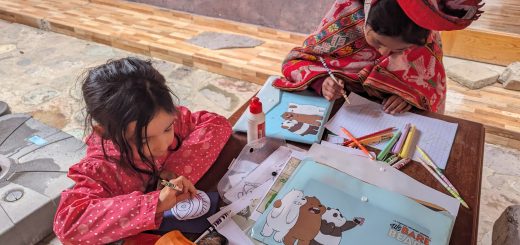
Family gap year tip: The kinds of things kids do to make sense of the world in everyday life (drawing, crafting, etc) can be useful during your family gap year. Make time for your kid(s) to create too!
If all of this feels a bit abstract and you’re seeking more concrete planning tips, check out Gap Year Association’s planning resources (mostly student focused but with some overlap for families). Happy planning!
If you’d like to bounce ideas around about your family gap year planning, feel free to reach out. We’d love to hear from you!